What is Robot Data Annotation?
Attaching labels to robot episodes, recording what the task was, whether it succeeded, and when key events happened.
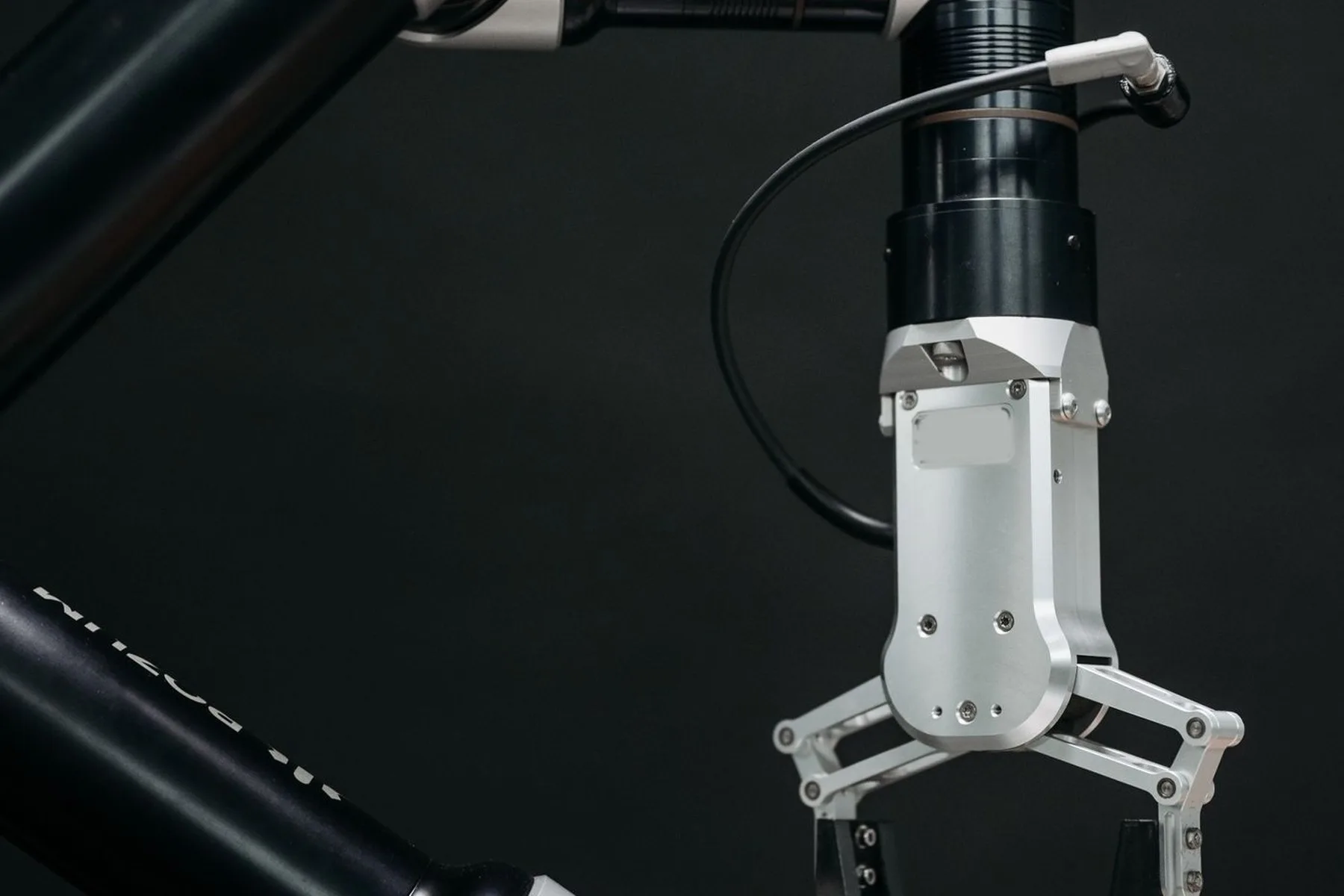
Robot annotation is mostly episode-level and temporal rather than spatial. The typical labels are a natural-language instruction for the episode, a success or failure verdict, contact events with timestamps, and sometimes object segmentation masks for key frames. The tooling is general-purpose (CVAT and Label Studio both handle video and time series), so the cost sits in the guideline, not the software.
The success label is where annotators disagree. "Did the grasp succeed?" has an obvious answer only until the object is dropped two seconds after release, or placed slightly off target, or handed over in the wrong orientation. A guideline that defines a hold period and a placement tolerance converts those arguments into a rule; without one, the same episode gets different labels from different annotators.
Pricing follows label depth and is quoted per episode rather than per hour: templated language labels and success verdicts commonly fall in the range of a few cents to a few tens of cents per episode, while per-frame segmentation masks are priced per image at the dollar level. Where success is already implicit in the teleoperation flow, no post-hoc verdict is needed at all. Annotating existing footage is one of the services most often commissioned on its own, and the deliverable that decides quality is the written convention.
Kinds of annotation
Episode-level labels attach once to a whole episode: the instruction in natural language, a success or failure verdict, and administrative fields such as the operator, the rig and the objects present. They are the cheapest labels to produce and the ones most projects actually need, because a policy trained on demonstrations has to learn what each demonstration was for.
Temporal labels attach to moments: first contact, grasp, release, drop and the boundaries between sub-tasks. They are what let a long episode be cut into stages, and what let a policy be evaluated at the second that decided the outcome. The guideline has to define each event precisely, down to which frame counts as the start, or two annotators will place the same event seconds apart.
Spatial labels attach to individual frames: bounding boxes, segmentation masks, keypoints. They are the most expensive by a wide margin, so they are usually applied to sampled frames or to a named object rather than to every frame. A quote should say which of the three levels it covers, because the same footage annotated at episode level and at pixel level are two different products.
What to specify when buying
Ask to see the written guideline before accepting a quote. It is where the cost sits, and it has to settle what annotators would otherwise argue about: what counts as a successful grasp, how long an object must stay held before the episode counts as a success, how far off target a placement may be and which style the instructions follow. A supplier who cannot show a guideline cannot show consistent labels.
Specify the level and the sampling. If spatial labels are wanted, say whether they cover every frame, key frames only or a fixed sample, since per-image pricing makes that choice the main cost lever. If the target is a vision-language-action model, say how many independent instructions each episode should carry and in what style, because instruction phrasing is training input, not documentation.
Specify what happens to failures. Episodes where the robot dropped the object, missed the target or needed a correction are the ones a policy learns most from, and the ones default collection practice quietly discards. Say whether failures are kept, labeled and delivered, and fix how labels are joined back to the data, by timestamp or frame index.
Related terms
-
Annotation
Attaching machine-readable labels to raw data, a transcript, an intent, a speaker identity.
-
Ground Truth
Human-verified labels good enough to serve as the training target.
-
Robot Manipulation Data
Episodes of a robot arm moving objects, recorded together with the commands that produced the motion.
Keep reading
-
Full glossary
Every term we explain, in one list.
-
How to buy training data
Where these terms actually show up, and which ones change a quote.
-
Help center
How a project runs, from specification to delivery.
Submit a sourcing request
Tell us the language, the hours, and what the data needs to look like. You will get a real number and a real timeline, not a range. If we cannot source it well, we will tell you that instead.
- Pilot batch before the full run, so problems surface early.
- Consent documentation delivered with the data.
- No medical or clinical data. No recorded telephone calls.
- You send the spec Language, hours, recording conditions, and the deadline.
- We reply within two business days A real number and a real timeline, not a range.
- You approve a pilot batch A small run first, so problems surface before the full order.
- Full run, then delivery with documents Audio, transcripts, and the consent record for every speaker.