What is Sim-to-Real Transfer?
Training a policy in simulation and getting it to work on physical hardware, across the gap between the two.
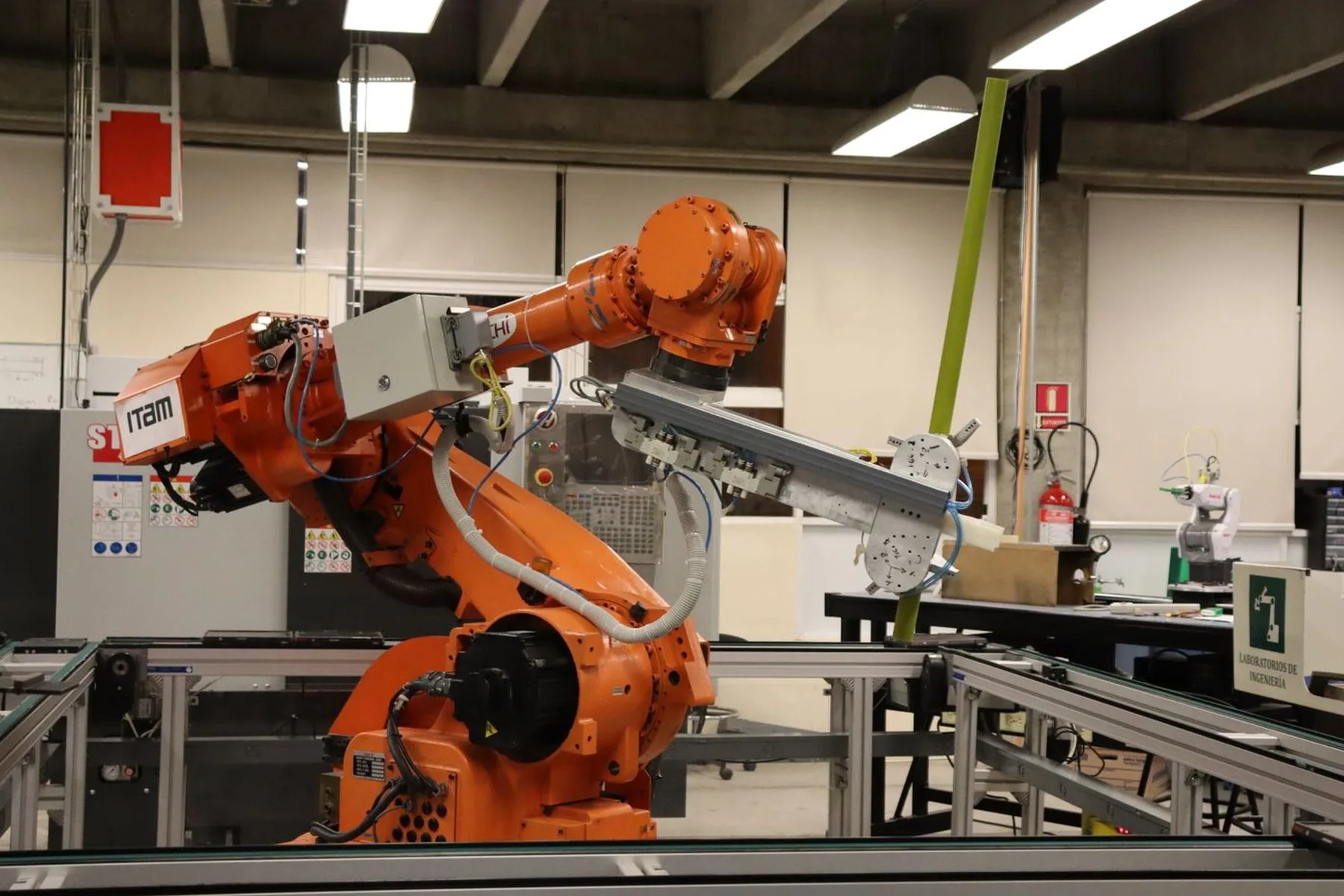
The standard tool is domain randomization: vary lighting, textures, friction and object mass in simulation until the real world looks like one more sample from the same distribution. The other half is system identification: measuring the real robot's dynamics and setting the simulator to match. MuJoCo and NVIDIA's Isaac Sim, with Isaac Lab on top, are the common engines; both run thousands of parallel environments on a single GPU.
The gap is not uniform. Locomotion and coarse reaching cross it well. Contact-rich tasks cross it badly: tight-tolerance insertion, deformable objects, cables, granular material and cloth all depend on contact physics that simulators approximate, and the approximation is where the policy fails. A sim-trained policy that works in the lab and fails in the field is usually failing on friction or contact stiffness, not on vision.
The cost structure is why sim is attractive: once the environment exists, extra samples are nearly free, and the expense is the engineering to build and validate the scene. The decision rule is task-first, if the failure mode you care about is contact, simulation is a supplement and real data is the product; if it is navigation or locomotion, simulation alone can be enough. Pipelines of this kind are engineering work rather than stocked data: a project is scoped to the task, and the deliverable is a validated environment plus the data it generates.
Approaches to closing the gap
Domain randomization is the first approach. Lighting, textures, friction, mass and sensor delays are varied across wide ranges in simulation, until the real world becomes one more sample from the same distribution. It works well when the failure mode is visual. It cannot repair physics the simulator models wrongly: randomizing a wrong model produces more wrong samples, not better ones.
System identification is the second. The real machine is measured, and the simulator is tuned until its dynamics line up; masses, friction, motor response and delays are the usual parameters. It complements randomization (one widens the distribution, the other centers it), and it needs time on the real hardware, which is why the two are usually combined rather than chosen between.
A third family accepts that the gap cannot be closed in simulation alone. A policy is trained in simulation and then adapted on the real robot with a small amount of real data, by fine-tuning, by learning a correction on top of the simulated policy, or by adjusting online while it runs. Real data becomes the finishing step rather than the bulk of the training set.
Where it shows up in a quote
Sim-to-real work is scoped as engineering, not sold by the hour. The deliverable is a working environment and the episodes it produces: the robot model, the scene, the sensor simulation, and a written statement of what the physics does and does not capture. Price it like software work, by the scope of the scene and the validation, not by the gigabytes produced.
The acceptance criterion should be a real-robot task, not a simulation metric. Ask how the environment is validated against the physical machine. A set of real runs the policy has to pass, with the same objects and conditions as deployment. An environment never checked against hardware is a hypothesis, and the quote should not treat it as a product.
The economics are front-loaded. Most of the cost is the engineering to build and validate the scene, and it is paid before any data exists, which makes this the least reversible line item in a data budget. Scope it in stages (a small scene validated against the real robot first, expansion after) rather than committing to a large environment on the strength of a demonstration.
Related terms
-
Robot Data Augmentation
Generating additional training episodes from existing ones by transforming images, goals or scene configurations.
-
Robot Manipulation Data
Episodes of a robot arm moving objects, recorded together with the commands that produced the motion.
-
Mobile Robot Navigation Data
Sensor logs of a robot moving through space, with the poses, maps and trajectories needed to train or evaluate navigation.
Keep reading
-
Full glossary
Every term we explain, in one list.
-
How to buy training data
Where these terms actually show up, and which ones change a quote.
-
Help center
How a project runs, from specification to delivery.
Submit a sourcing request
Tell us the language, the hours, and what the data needs to look like. You will get a real number and a real timeline, not a range. If we cannot source it well, we will tell you that instead.
- Pilot batch before the full run, so problems surface early.
- Consent documentation delivered with the data.
- No medical or clinical data. No recorded telephone calls.
- You send the spec Language, hours, recording conditions, and the deadline.
- We reply within two business days A real number and a real timeline, not a range.
- You approve a pilot batch A small run first, so problems surface before the full order.
- Full run, then delivery with documents Audio, transcripts, and the consent record for every speaker.