Indonesian Call Center Speech Data: What Makes It Usable for a Customer-Service Voice Model
Indonesian customer-service audio mixes Indonesian, Javanese and English loanwords in the same sentence. The decisions that decide whether the dataset trains well are made before the first call is recorded.
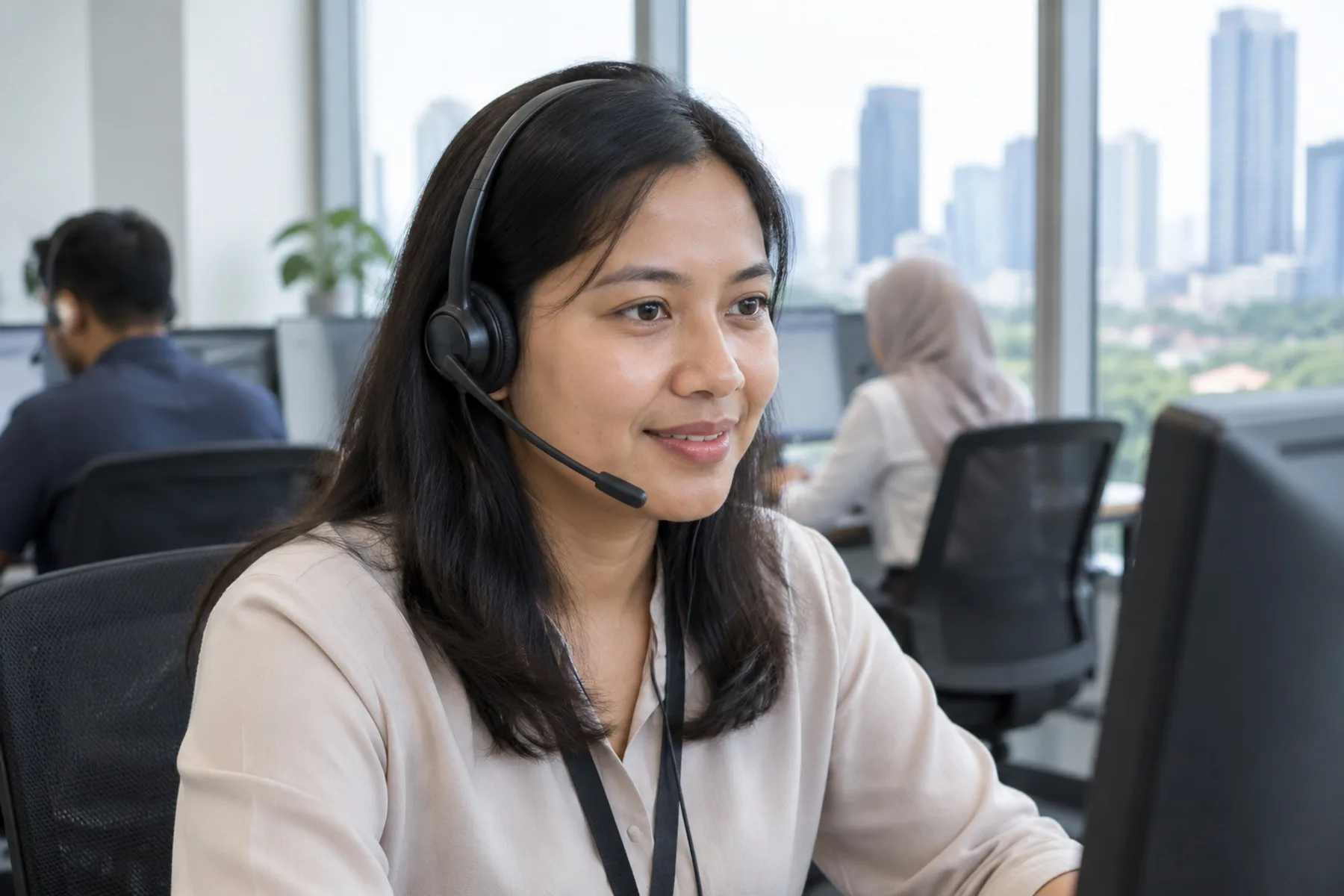
In a Jakarta call center, an agent speaks Indonesian, drops into Javanese or Betawi for a phrase, and borrows an English product term, all inside one sentence. Three languages in one utterance is the rule rather than the exception, and an Indonesian call center speech dataset that does not plan for it will be internally inconsistent in a way that only shows up during training.
Customer-service audio is also one of the hardest speech datasets to collect well, because the acoustic conditions are worse than a studio and the speakers are not professionals. An Indonesian speech dataset recorded from real calls is more faithful to production conditions and harder to label than the same hours recorded in a booth.
Code-mixing is the normal case, not an edge case
Urban Indonesian speech borrows heavily. Javanese and Betawi vocabulary appears in ordinary conversation in Java and Jakarta, and English loanwords dominate technology and commerce. Removing them produces text that no longer matches the audio; keeping them without a rule produces transcripts that differ from annotator to annotator.
The practical solution is a written convention applied consistently: which tokens are transcribed in their original form, which are normalised, and how a switch inside a sentence is marked. Without that convention, two annotators working on the same audio will disagree by several words on where the switch happens, and the disagreement is invisible until the dataset is audited.
Regional accent belongs in the metadata
Indonesian speakers from Java, Sumatra, Sulawesi and Bali do not sound the same, and a customer-service model deployed nationally will meet all of them. A dataset collected only in Jakarta teaches the model one accent and leaves it unprepared for the rest.
Recording each speaker city or province at recruitment costs nothing. Recovering it after delivery is usually impossible, and a corpus that mixed accents without recording them cannot be split later.
The acoustic conditions decide which model the data can train
Telephone audio is narrowband. That is fine if the deployed model will run in a telephone channel and a problem if it will run in a mobile app expecting wideband output. The channel has to match the target, and the specification should say which one is being delivered.
Background noise in a call center also behaves differently from studio noise. Overlapping agents, keyboard sound and room hum are part of what the model will hear in production, so aggressive denoising can remove signal the model needs rather than noise it does not.
A specification checklist for Indonesian customer-service audio
- Channel: telephone narrowband, wideband, or studio recording.
- Code-mixing convention, written down and applied by every annotator.
- Speaker metadata: city or province, and whether Javanese or another regional language is used.
- Whether both sides of the call are recorded or only the agent.
- Overlap policy: how simultaneous speech is labelled or excluded.
- Consent and retention rules for real customer calls.
- Acceptance check per accent group, not only on the pooled dataset.
The decision that matters is which channel and which accent coverage, not how many hours. Both are cheap to specify and expensive to discover missing at delivery.
For related pages, see Indonesian, the call center speech category, the full dataset briefs, and the technical reference on sample rates and channel effects.
Questions buyers ask
Should Indonesian call center transcripts keep Javanese and English words?
They should follow a written rule either way. Keeping the words preserves the audio faithfully but requires a labelling convention; normalising them produces cleaner text that no longer matches what was said.
Is telephone audio good enough to train a customer-service voice model?
It is good enough if the deployed model will also run on telephone audio. If the target is a wideband mobile experience, a narrowband corpus will teach the model the wrong channel.
Do I need speakers from outside Jakarta?
If the model will serve the whole country, yes. A Jakarta-only corpus teaches one accent; speakers from other islands sound different and will be underrepresented.
How should overlapping speech be handled?
Decide before recording. The two common options are to label overlap explicitly or to exclude it; choosing neither produces a corpus where annotators handled it differently.
What about consent for real customer calls?
Consent and retention rules have to be settled before collection, not after. A corpus assembled from calls without documented consent is a liability regardless of its audio quality.