Synthetic UAV Data: How to Tell Whether It Will Transfer to a Real Drone
Synthetic drone data is cheap to generate and easy to get wrong. Here is what decides whether a synthetic UAV dataset transfers, and what has to be checked before it is used.
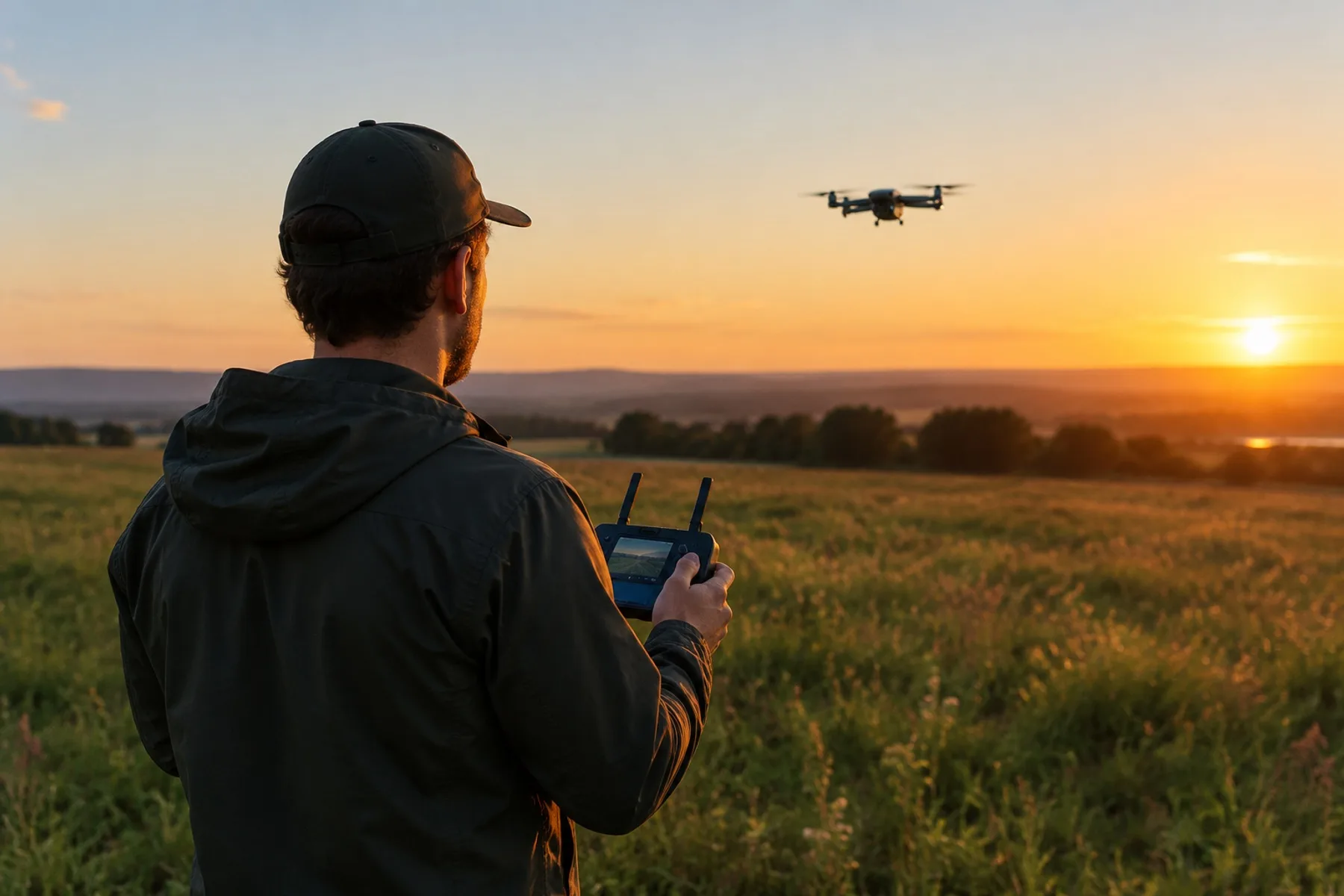
Synthetic drone data solves a real cost problem. Recording real flights requires airspace, a pilot, hardware and time, and the resulting dataset is limited to the conditions that actually occurred. Generating the same footage in a simulated environment is cheaper per frame and can cover conditions that would be expensive or unsafe to fly.
The difficulty is that synthetic footage and real footage are not the same distribution. A model trained only on synthetic images can fail on real video even when the synthetic images look convincing to a person. Whether a synthetic UAV dataset transfers is a question about the gap, not about the visual quality.
Visual realism is not the same as transfer
Photorealistic rendering improves appearance but does not guarantee that the model learns the right cue. Lighting, motion blur, sensor noise and lens artefacts differ between a renderer and a real camera, and a model can lock onto a rendering artefact that happens to correlate with the label.
The practical test is a small real-world sample used only for evaluation. If the model trained on synthetic data performs on real footage at a level close to a model trained on real data, the gap is manageable for that task. If it does not, more synthetic volume usually does not fix it.
Dynamics matter as much as pixels
A flight trajectory has to be physically plausible. Turns, acceleration and altitude changes that a planner produces without a flight model can be impossible for a real airframe, and data recorded along an impossible trajectory teaches a policy that cannot be flown.
Any synthetic UAV dataset should therefore record the dynamics model used, the airframe class it assumes, and the constraints applied to the trajectory. These are metadata, and without them a buyer cannot tell whether the motion in the data is achievable.
Scene diversity decides what the dataset can generalise to
A synthetic dataset built from a small number of scenes will generalise to those scenes and little else, however many trajectories it contains. Diversity has to be counted in scenes, weather and lighting conditions, and object variety, not in frames.
The specification should state how many distinct scenes, which environment types, and which conditions are covered. A purchase described only as "fifty thousand records" says nothing about any of that.
Checklist before buying synthetic UAV data
- Number of distinct scenes and environment types.
- Lighting, weather and time-of-day coverage.
- Renderer and sensor model, with noise and lens characteristics stated.
- Dynamics model and airframe class assumed by the trajectory planner.
- Whether a real-world evaluation set is included or available.
- Label schema and how labels were generated or verified.
- Documented validation of synthetic-to-real transfer for the intended task.
The decision that matters is whether the vendor can show transfer evidence, not how many frames the dataset contains. Volume is cheap to generate; evidence is not.
For related pages, see synthetic data, the full dataset briefs, the technical reference, and autonomous driving data for the same transfer problem in a related domain.
Questions buyers ask
Can a model trained only on synthetic drone data work on real footage?
Sometimes, but only if the gap for that specific task has been measured. Visual realism alone is not evidence; a small real-world evaluation set is.
How many synthetic records do I need?
Record count is the wrong unit. What matters is how many distinct scenes and conditions are covered, and whether transfer has been validated for the intended task.
Why does trajectory plausibility matter for UAV data?
Because a trajectory that a real airframe cannot fly teaches a policy that cannot be deployed. The dynamics model and airframe assumptions have to be recorded.
What should a synthetic dataset supplier document?
Scene count, conditions, renderer and sensor model, dynamics assumptions, label generation, and any synthetic-to-real validation. Without those, a buyer cannot judge whether the data transfers.