Embodied AI Data Collection: What a Task Matrix Buys You That Hours Do Not
Robot data is bought by task coverage, not by duration. Here is what a task matrix is, why it changes the cost, and which quality signals decide whether a batch trains a usable policy.
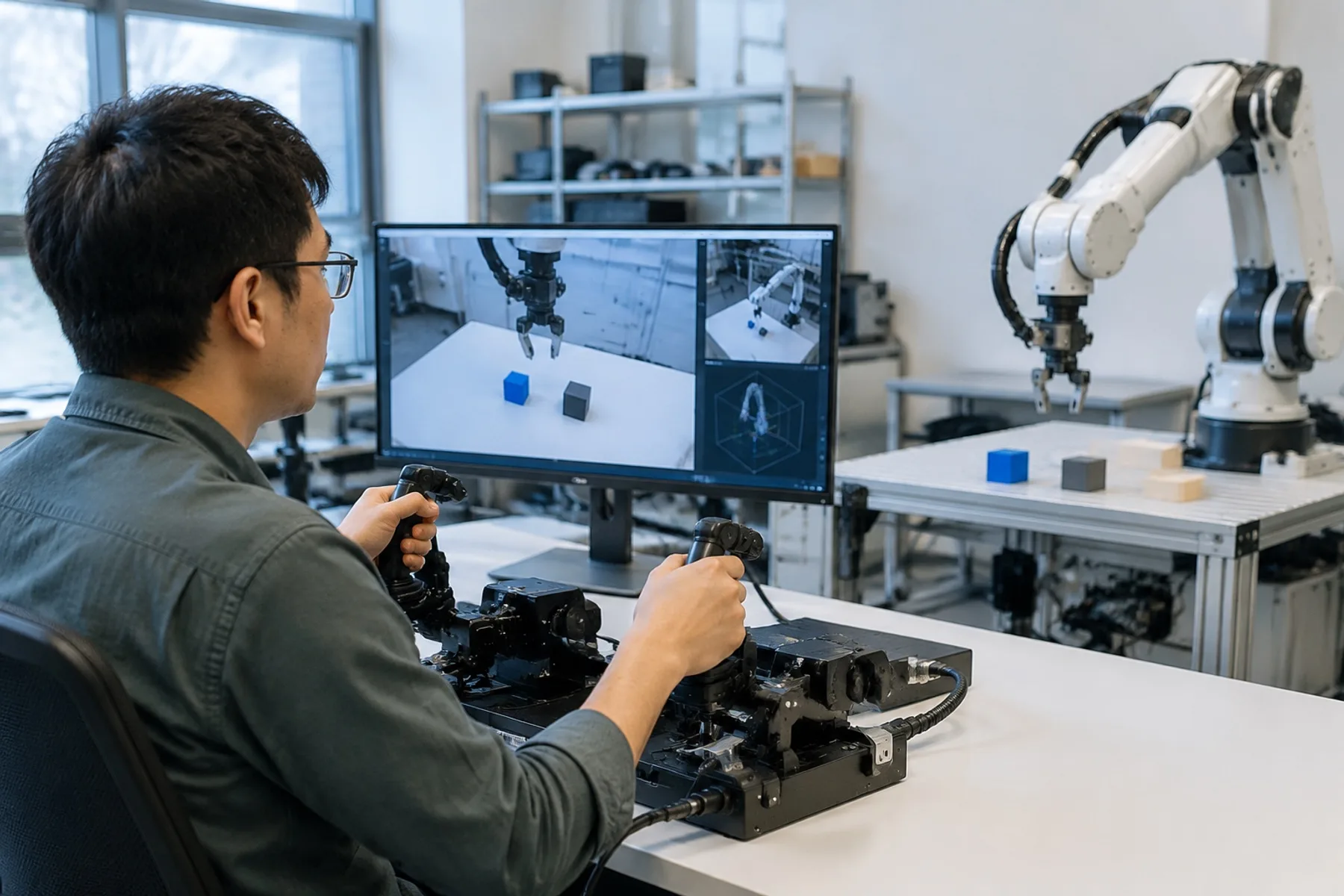
Speech datasets are scoped in hours. Robot datasets are not, or should not be. An hour of robot manipulation data from one task, one operator and one rig says very little about the next task, and a buyer who orders by duration receives a number that is easy to produce and hard to use.
The scoping unit for embodied AI data is the task matrix: which tasks, on which embodiment, with which objects, under which variations. A task matrix is more work to specify and far cheaper than discovering at delivery that the coverage is wrong.
Why hours mislead in robot data
Two hundred hours of one repetitive pick-and-place task and two hundred hours spread across twenty tasks are not the same product. The first supports imitation learning on that one motion; the second exposes a policy to variation, which is usually the point of collecting robot data at all.
Coverage is also uneven in difficulty. Some tasks are quick to record and cheap to repeat; others require specific objects, a specific robot or a specific environment. Ordering by hours hides that difference until the budget is already committed.
The capture setup determines what the data is worth
Manipulation data can be recorded by teleoperation with motion capture, with instrumented gloves, with camera-based hand tracking, or by a human demonstrating directly. Each route produces a different signal, and the differences show up downstream.
The quality properties that matter are measurable: smoothness of the teleoperation signal, latency between the operator input and the robot, pose tracking accuracy, joint trajectory smoothness in position and velocity, and how often the trajectory hits velocity or torque limits. Low-quality teleoperation produces jittery trajectories, and a policy trained on them learns the jitter.
Consistency across the batch is the hard part
Robot data collected over weeks drifts. Operators change, lighting changes, the rig is recalibrated, objects are replaced. A batch that looks consistent in aggregate can contain segments recorded under different conditions, and a policy trained on it may learn the difference between sessions rather than the task.
Session metadata is the cheap defence: who operated, on which rig, with which calibration, on which date. Recording it costs almost nothing at capture time and is usually unrecoverable afterwards.
A task matrix checklist
- Tasks named explicitly, not grouped into categories.
- Embodiment and end effector per task, with the robot model recorded.
- Object set and variation (shape, material, lighting) per task.
- Teleoperation route and controller type, recorded per session.
- Quality signals captured at record time: latency, tracking error, smoothness.
- Session metadata: operator, rig, calibration, date.
- Acceptance check per task cell, not only on the pooled batch.
The decision that matters is which cells of the matrix are covered, not how many hours were recorded. A small matrix with clean, consistent cells is more useful than a large batch with unknown coverage.
For related pages, see embodied AI data, the embodied AI category, robot data collection services, and the full dataset briefs.
Questions buyers ask
How many hours of robot data do I need?
Hours are the wrong unit for robot data. What matters is which tasks, on which embodiment, with which object variations. A task matrix is the thing to specify; the hours follow from it.
What quality signals should be checked at capture?
Signal smoothness, input-to-robot latency, pose tracking accuracy, joint trajectory smoothness in position and velocity, and how often trajectories hit velocity or torque limits. These are measurable at record time and expensive to recover later.
Why does teleoperation quality matter so much?
Because a policy trains on what it is given. Jittery, low-latency-compensated trajectories teach the policy to reproduce the jitter rather than the task.
What metadata should every session record?
Operator, rig and calibration, date, and the object set used. Session metadata is nearly free at capture and usually unrecoverable after delivery.