What is Open X-Embodiment?
A pooled collection of robot datasets spanning 22 different robot embodiments, built to test whether data from one robot helps another.
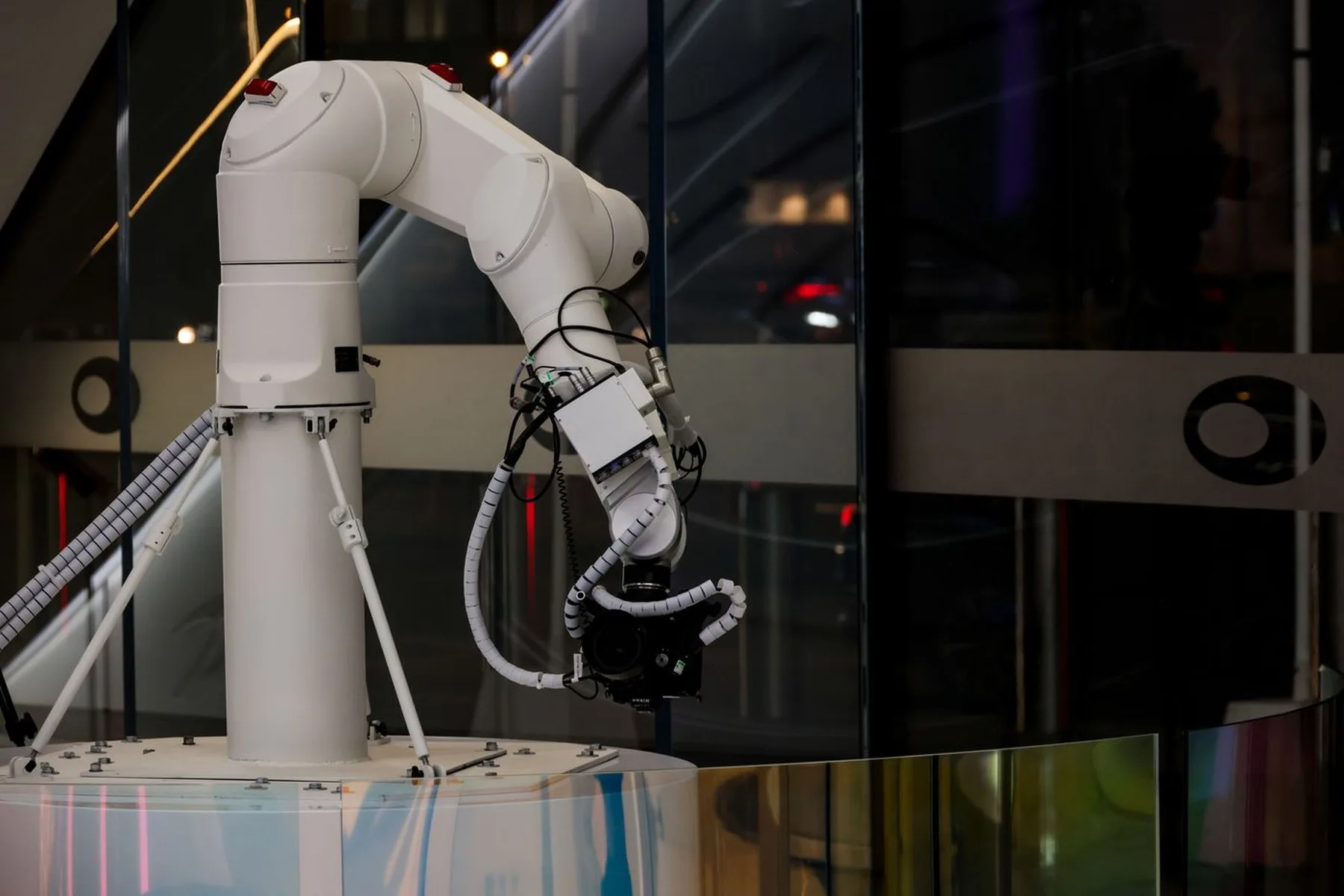
Open X-Embodiment, released in late 2023, is a pooling effort rather than a new collection: sixty existing robot datasets from many labs were converted into one shared format (RLDS) and released together. The result spans 22 distinct robot embodiments, more than a million real episodes and several hundred distinct skills. The scale is not the interesting part. The embodiment count is.
The question it was built to answer is whether a robot learns better from data collected on other robots. The answer was yes: models trained on the pooled set outperformed models trained only on data from the target robot. That result is why cross-embodiment data is now a standard line item in robot learning budgets, and why "which embodiments are in it" is a more useful question to ask than "how many hours".
Two caveats matter if you are buying or assembling something similar. Pooling heterogeneous sources means pooling heterogeneous conventions: camera placement, action spaces, control rates and success criteria all differ, and the conversion into a shared format is where information quietly goes missing. And the pool leans toward tabletop manipulation with parallel-jaw grippers; if your platform is a humanoid or a dexterous hand, the cross-embodiment benefit is real but thinner.
What is inside the pool
The pool is heterogeneous by design. Its entries differ in robot body, arm count, gripper type, camera placement, control rate and action space, and they were collected by different teams under different conventions. The shared format is a wrapper, not a homogenizer: it makes the datasets readable by one training script, but it does not make them the same product.
What the entries have in common is the shape of a sample: camera observations, robot state, the action taken, and often a language instruction, stored episode by episode. What varies is everything around that shape: how many camera angles there are, whether actions are joint positions or end-effector poses, how fast the control loop ran, and how success was judged.
The composition leans toward tabletop manipulation with parallel-jaw grippers, because that is what most of the contributing teams had. That is the pool's center of gravity, and it is the first thing to check against your own platform: the further your robot sits from that center, the thinner the cross-embodiment benefit becomes.
What the pool changes for a buyer
The result the pool demonstrated is that a model trained on data from many robots can outperform one trained only on data from the target robot. That is why cross-embodiment data became a standard budget line. The practical version for a buyer: pooled data is usually pretraining material, and the fine-tuning set still has to be collected on the robot you actually deploy.
If you are assembling a pool, or buying a converted one, the specification lines that matter are the embodiment mix and the conversion. Which robots, which grippers, which skills, how many distinct scenes, and how the action spaces and control rates were reconciled into one format. Conversion is where information quietly goes missing, and the buyer discovers it at training time.
Failure coverage is the third line. A pool assembled from successful demonstrations teaches success; a policy that never saw a failed grasp has no way to recognize one. Ask what share of the episodes record a failure, and whether that failure is labelled or merely present.
Related terms
-
DROID Dataset
A large in-the-wild robot manipulation dataset collected by a multi-lab consortium, notable for scene diversity rather than task repetition.
-
Robot Manipulation Data
Episodes of a robot arm moving objects, recorded together with the commands that produced the motion.
-
LeRobot
An open-source library and dataset format for robot learning, which fixes how episodes, video and state are stored so datasets can be shared.
Keep reading
-
Full glossary
Every term we explain, in one list.
-
How to buy training data
Where these terms actually show up, and which ones change a quote.
-
Help center
How a project runs, from specification to delivery.
Submit a sourcing request
Tell us the language, the hours, and what the data needs to look like. You will get a real number and a real timeline, not a range. If we cannot source it well, we will tell you that instead.
- Pilot batch before the full run, so problems surface early.
- Consent documentation delivered with the data.
- No medical or clinical data. No recorded telephone calls.
- You send the spec Language, hours, recording conditions, and the deadline.
- We reply within two business days A real number and a real timeline, not a range.
- You approve a pilot batch A small run first, so problems surface before the full order.
- Full run, then delivery with documents Audio, transcripts, and the consent record for every speaker.